
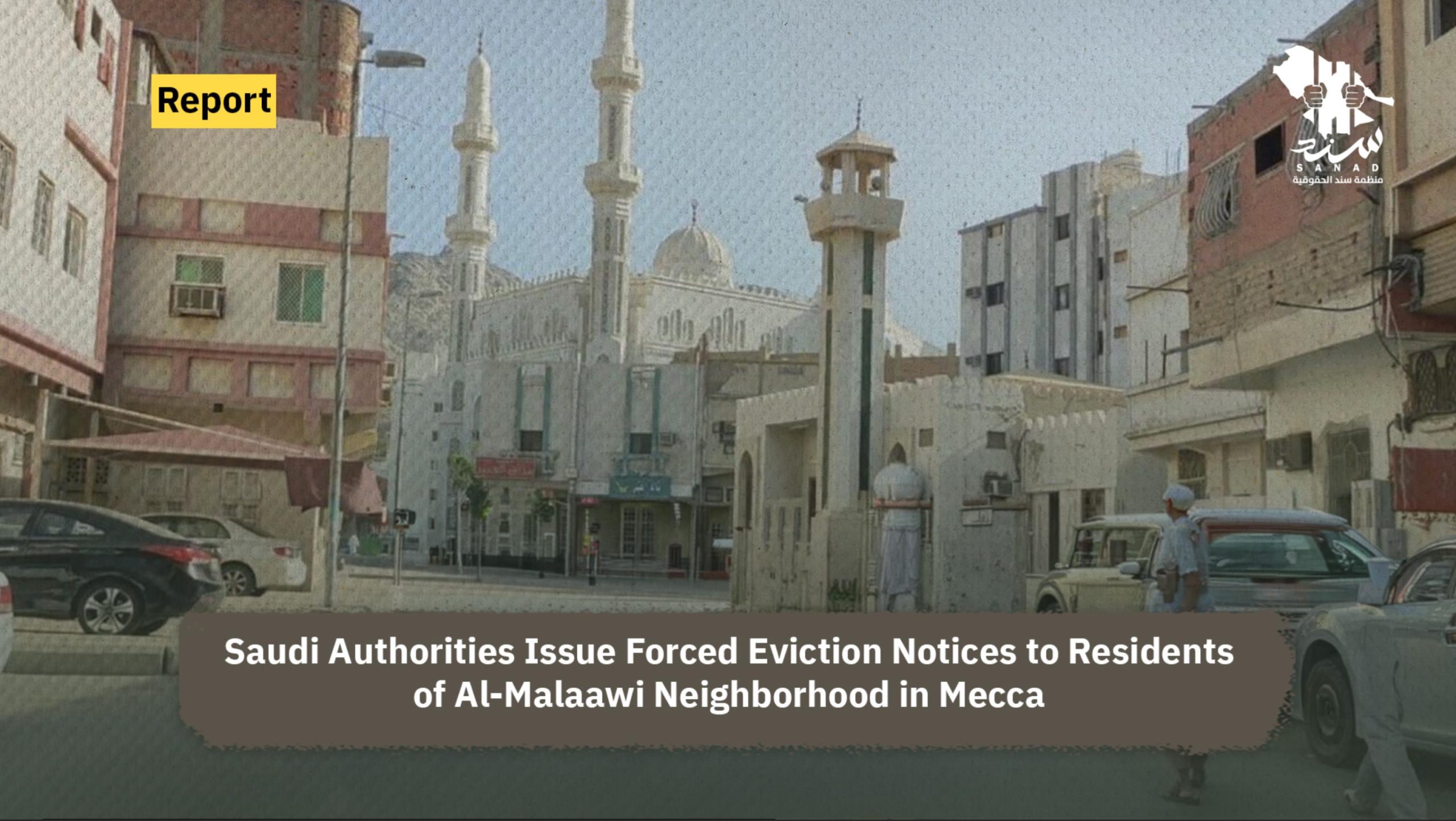
Saudi Authorities Issue Forced Eviction Notices to Residents of Al-Malaawi Neighborhood in Mecca
London – January 19, 2026 – Over recent weeks, SANAD Human Rights Organization has closely monitored reports concerning a forced displacement campaign affecting parts of the Al-Malaawi neighborhood in Mecca. Numerous residents have received eviction notices ordering them to vacate their homes by the end of March, after which all basic services—including water and electricity—are scheduled to be cut off.
Residents were issued these eviction notices without being granted any genuine opportunity for consultation, objection, or legal appeal. Given the repressive climate prevailing in the country, it has become virtually impossible for residents to publicly express opposition, as doing so could result in imprisonment or enforced disappearance, as previously witnessed in the case of the Howaitat tribe.
In recent years, multiple forced displacement operations and home demolitions have taken place in Jeddah and the Howaitat regions, placing immense pressure on affected families and causing widespread suffering. These actions were carried out in the absence of fair compensation, adequate resettlement plans, or the provision of suitable housing alternatives. The displacement of parts of Al-Malaawi does not appear to be an isolated incident; rather, it raises serious concerns about the Saudi authorities’ continued intent to forcibly displace residents across several areas of Mecca.
To this day, many members of the Howaitat tribe who opposed forced displacement remain arbitrarily detained, with some receiving lengthy prison sentences and others facing death sentences. Saudi authorities also killed Abdulrahim Al-Howaiti during the enforcement of the forced displacement campaign against the tribe.
These forced displacement operations are being carried out under Saudi Crown Prince Mohammed bin Salman’s Vision 2030, which is publicly presented as a reform agenda. In practice, however, it has resulted in widespread suffering for large segments of the population and has been accompanied by forced evictions, arbitrary arrests, and an unprecedented surge in executions.
In this context, SANAD spokesperson Fahd Al-Ghoweidi stated:
“SANAD is deeply concerned by the Saudi authorities’ consolidation of a policy of ‘silent displacement’ in Mecca and Jeddah—a policy that is reproducing the tragedy experienced by the Howaitat people, in a manner that falls far below minimum humanitarian and legal standards.”
Al-Ghoweidi noted that the continued eviction of residential neighborhoods, including Al-Malaawi, without providing equivalent housing alternatives or fair compensation, and without allowing residents access to legal remedies or avenues of objection, represents a new form of repression. He added:
“Political repression today is manifesting as ‘urban authoritarianism,’ aimed at uprooting citizens from their historical and social roots in favor of investment projects from which ordinary people see no benefit.”
He further emphasized that forced displacement cannot be separated from violations of the right to security, stating:
“At its core, forced displacement strips citizens of safety and security—contrary to the state’s claims. There is no meaning to security without housing. Linking eviction orders to the cutting of essential services such as water and electricity constitutes collective punishment intended to break the will of residents.”
Accordingly, SANAD has called for the immediate suspension of all ongoing displacement operations—not only in Al-Malaawi, but across all affected areas—while stressing the need to end the security-based approach that criminalizes peaceful opposition. Al-Ghoweidi stated:
“We are not only calling for the immediate halt of displacement in Al-Malaawi and elsewhere, but also for the dismantling of the security framework that criminalizes freedom of expression and turns peaceful opposition to property confiscation into a so-called national security offense—one that can result in imprisonment or enforced disappearance.”
Concluding his remarks, Al-Ghoweidi said:
“True development is that which places human dignity and the fundamental rights to education, healthcare, and housing at the center of its priorities—not development built on the destruction of citizens’ rights.”