
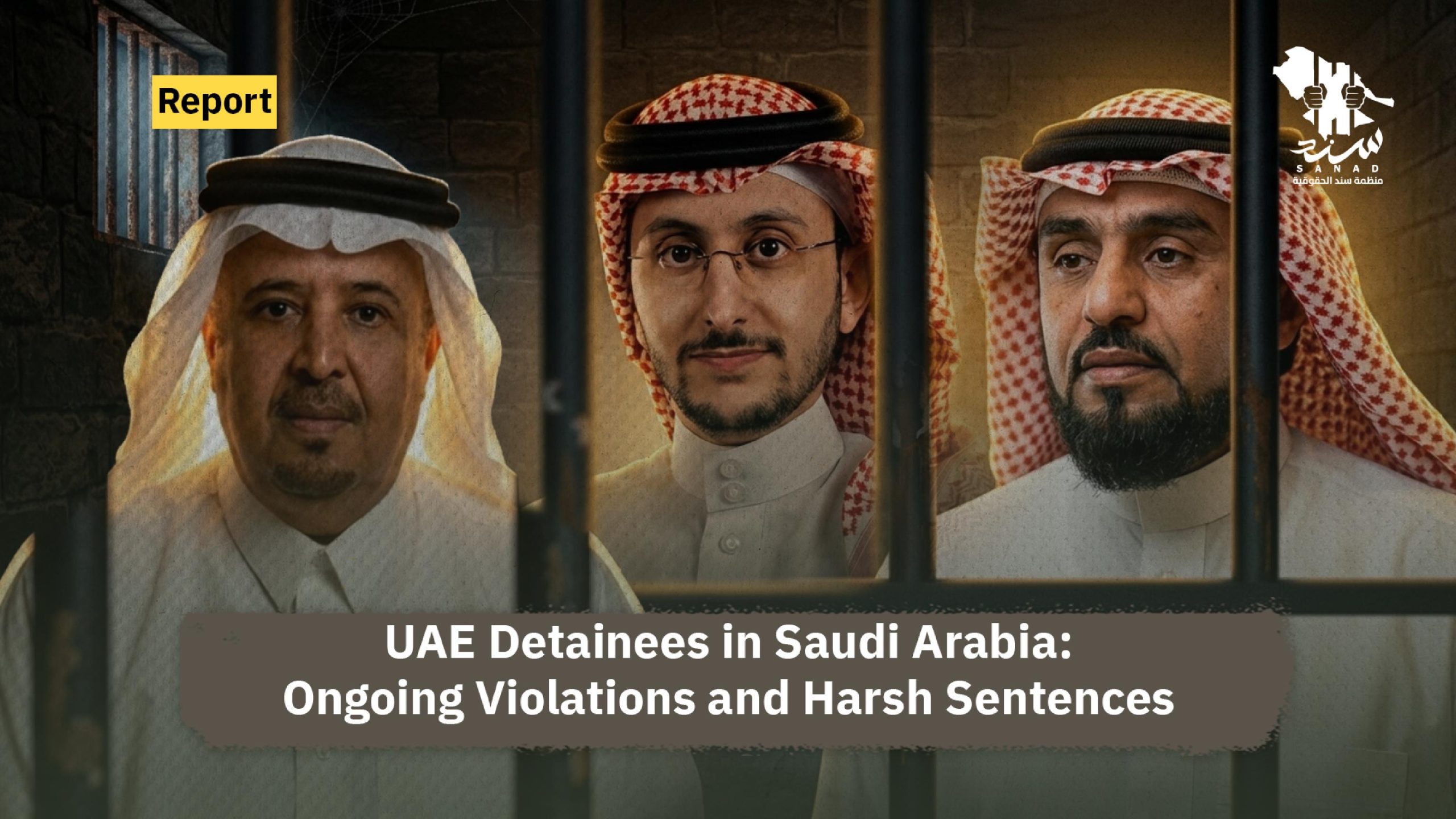
UAE Detainees in Saudi Arabia: Ongoing Violations and Harsh Sentences
Amid the wide range of reasons for arrest in Saudi Arabia—most of which stem from the suppression of freedom of expression and the persecution of personal and political views—the case of UAE detainees stands out as a stark example of how criminalization has expanded to include expressing opinions on regional issues, criticizing the policies of allied states, or holding views that do not align with the prevailing political climate.
The term “UAE detainees” refers to individuals arrested by Saudi authorities for criticizing the United Arab Emirates or for views attributed to them regarding its policies. Many have spent years in prison and isolation, with some remaining behind bars for more than a decade. Despite periods of close alliance as well as political tensions between Saudi Arabia and the UAE, the situation of these detainees has remained unchanged. Shifts in bilateral relations have neither led to their release nor eased the impact of their detention on them and their families.
These cases further demonstrate that arrest in Saudi Arabia is often driven not by genuine criminal conduct or legitimate legal concerns, but by the use of state security powers to punish opinions and deter free expression. Through this report, SANAD Human Rights Organization sheds light on the case of UAE detainees in Saudi Arabia and the serious violations it represents of freedom of expression, the right to a fair trial, and human dignity.
In this context, SANAD’s official spokesperson, Fahad Al-Ghweidi, said the case of UAE detainees exposes a striking contradiction in the Saudi authorities’ approach to freedom of expression. He noted that Saudi-UAE relations have alternated between close cooperation and periods of tension, at times even involving public exchanges of criticism between officials. Yet while no state official has been held accountable for such statements, ordinary citizens face arrest and prosecution simply for expressing similar opinions or criticizing the policies of another country.
Al-Ghweidi added that “the issue is not the offense itself, but who holds the power and privilege to offend.” He said that criminalizing criticism of another country under the charge of “insulting a friendly state” demonstrates that repression in Saudi Arabia is no longer confined to domestic affairs but has expanded to include opinions on regional issues and the policies of allied states. He also stressed that this standard is inherently selective, as the same opinion may be tolerated—or even encouraged—at one point, only to become grounds for prosecution and imprisonment later, depending on shifting political relations rather than any clear or just legal standard.
Al-Ghweidi emphasized that the core issue is the absence of any safe space for peaceful expression, leaving even those who believe their views align with the government’s position vulnerable to changing political calculations. He stressed that SANAD’s mission is to defend victims of injustice, keep their cases in the public eye, and work to alleviate their suffering. He reaffirmed that the organization’s demand remains clear: the immediate and unconditional release of all prisoners of conscience and an end to the criminalization of peaceful expression, whether related to domestic affairs or opinions on the policies of other states.
Dr. Mohammed Al-Hudhayf: More Than a Decade Behind Bars for Criticizing the UAE
On March 19, 2016, Dr. Mohammed Al-Hudhayf returned to Saudi Arabia from Turkey, only to be arrested upon arrival at King Khalid International Airport in Riyadh. More than ten years later, he remains behind bars.
Al-Hudhayf was arrested over his articles, public statements, and opinions criticizing the UAE. Saudi authorities charged him with “insulting a friendly state,” claiming his remarks harmed the country’s interests.
In June 2018, he was sentenced to five years in prison followed by a five-year travel ban. However, in February 2021, rights sources revealed that the original sentence had been overturned and increased to nine years, before being further extended to 13 years in September 2021.
His ordeal has gone beyond harsh sentences and secret proceedings. He has reportedly endured torture, beatings, electric shocks, placement alongside psychiatric patients, and denial of adequate medical care.
In March 2021, Al-Hudhayf staged an eight-day hunger strike to protest torture and ill-treatment in Al-Ha’ir Prison, including being held with psychiatric patients in conditions that endangered his health and safety.
More than a decade after his arrest, Dr. Mohammed Al-Hudhayf continues to suffer from multiple illnesses worsened by deliberate medical neglect, while remaining imprisoned for peacefully expressing his views and criticizing the UAE.
Dr. Ali Al-Tuwati Arrested Over Tweets Criticizing UAE Policies
In late 2021, Saudi authorities arrested Dr. Ali Al-Tuwati Al-Qurashi, a prominent writer and economic and strategic analyst, over tweets criticizing UAE policies. No information about his whereabouts or legal status has been made public since.
Dr. Al-Tuwati is a distinguished academic and former military official. He holds a PhD in Regional Economics and Public Finance from Syracuse University and previously served in senior positions within the Saudi Ministry of Defense.
Essam Al-Zamil: 15 Years in Prison, Including Charges of Insulting the UAE
In September 2017, economist Essam Al-Zamil was arrested while returning from an international conference in the United States. He remains imprisoned to this day.
Among the charges brought against him was allegedly insulting the UAE and its leadership. He was sentenced to 15 years in prison and has reportedly been subjected to multiple abuses in detention, including prolonged solitary confinement.
Saudi authorities also imposed travel bans on all members of his family, reflecting a pattern of collective punishment frequently imposed on the families of prisoners of conscience.
Saudi Media Authority Refers Citizen to Prosecution Over Alleged Insult to the UAE
Saudi Arabia’s General Authority for Media Regulation summoned a citizen accused of insulting a “sisterly state”—understood to refer to the UAE—during a social media audio discussion. The authority announced that it had completed legal procedures and referred the case to the Public Prosecution under the Anti-Cybercrime Law.
Reports identified the individual as Ministry of Information adviser Hussein Al-Shammari and claimed he was later arrested. However, SANAD Human Rights Organization has been unable to independently verify these reports or confirm the identity of the individual mentioned in the authority’s statement.
SANAD’s Demands Regarding UAE Detainees in Saudi Arabia
The case of UAE detainees in Saudi Arabia reveals the widening scope of repression, where peaceful expression—even on regional issues or the policies of other states—has become grounds for arrest, prosecution, and harsh sentences. The cases of Dr. Mohammed Al-Hudhayf, Dr. Ali Al-Tuwati, Essam Al-Zamil, and others reflect a clear pattern of targeting individuals for their views and criticism, without any genuine crime warranting punishment.
These cases also show that violations do not stop at arrest, but extend to unfair trials, torture, ill-treatment, medical neglect, solitary confinement, and restrictions imposed on families, turning punishment into a tool of collective retaliation. The continued detention of these prisoners, despite the passage of many years, confirms that Saudi Arabia’s security and judicial apparatus is being used to silence independent voices and deter society from exercising its right to expression.
Accordingly, SANAD Human Rights Organization calls on Saudi authorities to immediately and unconditionally release all prisoners of conscience, foremost among them the UAE detainees, and to stop criminalizing peaceful expression. SANAD also calls for accountability for those responsible for these violations, reparations and fair compensation for victims and their families, respect for human dignity, and the protection of freedom of opinion and expression in Saudi Arabia.