
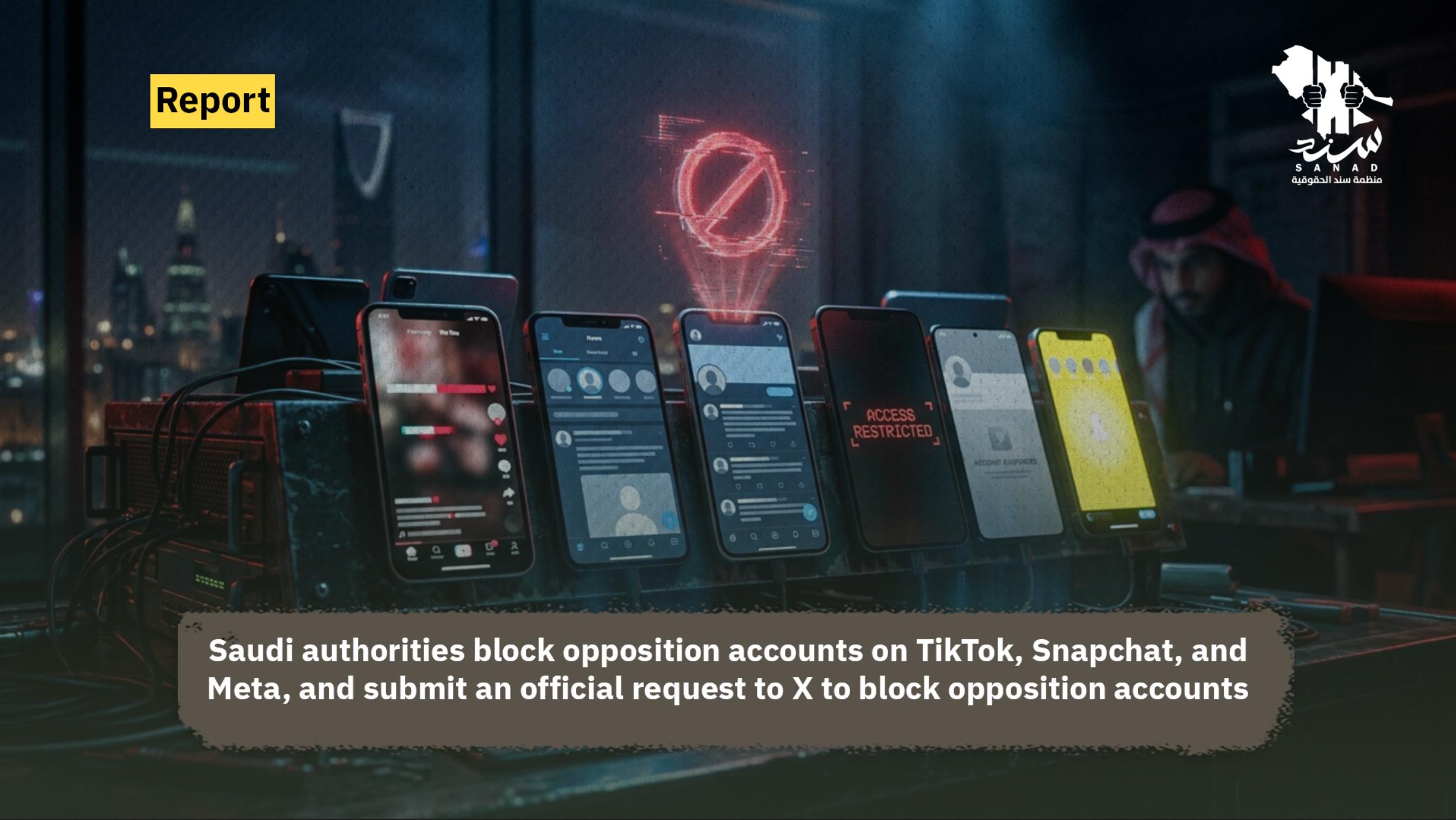
Saudi authorities block opposition accounts on TikTok, Snapchat, and Meta, and submit an official request to X to block opposition accounts
SANAD Human Rights Organization expresses deep concern over the expanding restrictions on digital freedom of expression in Saudi Arabia, particularly amid the repeated removal or restriction of accounts belonging to dissidents, activists, and journalists across social media platforms. The organization believes that the digital sphere has become one of the last remaining spaces for independent voices, amid the continued suppression of traditional media and the shrinking of public space.
In recent months, SANAD has documented an escalating pattern of digital targeting affecting major social media platforms, beginning with TikTok, followed by Meta platforms including Facebook and Instagram, then Snapchat, and most recently X. This gradual expansion of blocking and restriction measures points to a coordinated approach aimed at controlling online public discourse and limiting the ability of dissidents and activists to communicate their views to the public.
This form of digital repression extends beyond targeting individuals or silencing opposition accounts. It also deprives users inside Saudi Arabia of access to peaceful critical and reform-oriented content. As a result, blocking and account restrictions have become tools for shrinking public debate, undermining the right to access information, and preventing independent voices from participating in public discussion.
SANAD Human Rights Organization affirms that these practices constitute a clear violation of the right to freedom of opinion and expression, including the freedom to seek, receive, and impart information and ideas through any media and regardless of frontiers, as guaranteed under Article 19 of the Universal Declaration of Human Rights and Article 19 of the International Covenant on Civil and Political Rights. These measures also contradict Article 32 of the Arab Charter on Human Rights, which guarantees the right to information, freedom of opinion and expression, and the freedom to seek, receive, and impart information through any medium.
First: TikTok
TikTok was among the first platforms targeted in this digital campaign. SANAD Human Rights Organization documented the blocking of Saudi opposition accounts on the platform in a widespread and nearly comprehensive manner, preventing users inside the Kingdom from accessing accounts belonging to activists abroad.
The targeted account holders did not receive any official notification or email explaining the reasons for the blocking, the authority behind the request, or the legal basis used. Instead, they discovered the restrictions unexpectedly when their accounts became inaccessible to users inside Saudi Arabia, without any explanation or transparent mechanism for appeal or objection.
Second: Meta
Meta platforms, including Facebook and Instagram, were also affected by this campaign. Accounts such as those of Nasser Al-Qarni and Khat Al-Balda, among others, were blocked as part of the same pattern aimed at restricting the reach of reformist and human rights voices inside the Kingdom.
As in previous cases, the blocking was carried out without prior notice to the affected individuals, without providing clear reasons, and without allowing them the right to challenge the decision. This raises serious concerns about whether technology companies are fulfilling their human rights responsibilities, particularly when complying with government requests issued by authorities known for using vague laws to suppress freedom of expression.
Under the United Nations Guiding Principles on Business and Human Rights, companies have an independent responsibility to respect human rights, including conducting human rights due diligence, assessing the impact of their decisions on users, and providing effective remedy mechanisms when harm occurs.
Third: Snapchat
The campaign also extended to Snapchat, where accounts belonging to prominent activists, including Omar bin Abdulaziz, Nasser Al-Qarni, and Mishaal Al-Buraq, among others, were blocked. The account owners found themselves suddenly inaccessible to users inside the Kingdom, without prior notice or any official explanation regarding the legal basis for the action or the authority requesting it.
The danger of this pattern lies in the fact that it does not target specific content proven to violate clear and defined standards, but rather targets the entire digital presence of individuals known for opposition or reformist views. This means that blocking has shifted from being a tool to address specific content into a tool for punishing political and human rights identities.
The absence of transparency and appeal mechanisms also makes these actions inherently arbitrary, as they deprive individuals of knowing why they were restricted and deprive users inside Saudi Arabia of access to diverse information and opinions.
Fourth: X Platform
In the case of X, emails received by several activists indicate that Saudi authorities submitted an official request to the platform seeking to block a number of accounts and prevent users inside Saudi Arabia from accessing them. However, X has not implemented the request so far.
Documents obtained by SANAD show that the request is based on a decision issued by the Saudi Public Prosecution, Office of the Attorney General, ordering the blocking of the accounts listed in the attached statement on X and restricting access to them from within the Kingdom. The decision states that the content published by those accounts was considered in violation of Saudi regulations, based on the Cybercrime Law, particularly provisions criminalizing what is described as “harming public order,” “religious values,” or “public morals.”
Cybercrime Law: A legal tool for suppressing expression
Saudi authorities rely in many cases of digital censorship and prosecution on the Cybercrime Law as a legal framework that enables the criminalization of broad forms of online expression. Its provisions are written in vague and broad terms that allow authorities to expand criminal liability to include peaceful expression, critical opinions, and independent political or human rights content.
Under this law, Saudi authorities have arrested hundreds of Saudi citizens and sentenced many of them to decades in prison. Peaceful expression in Saudi Arabia is now effectively criminalized, even when limited to a single tweet, which may expose its author to years in prison or even execution, as in the case of journalist Turki Al-Jasser.
As a result, the law extends far beyond addressing cybercrime in the narrow sense. It creates an environment of deterrence and self-censorship, where individuals, journalists, and human rights defenders may avoid publishing legitimate opinions or information out of fear that it could be interpreted as harming public order, religious values, or public morals. This broad use of criminal provisions transforms the law into a tool for restricting digital public space rather than a narrowly tailored mechanism for addressing clearly harmful acts.
Responsibility of social media platforms: No neutrality in the face of repression
Compliance by social media platforms with blocking or restriction requests issued within repressive legal environments such as Saudi Arabia cannot be viewed as a neutral legal or procedural matter. Geoblocking accounts or posts may, in practice, amount to complete removal when it deprives the intended audience of access to legitimate human rights or political speech.
These companies cannot simply justify their actions by claiming they are complying with local government orders. Their publicly stated commitments to human rights and freedom of expression require them to assess government requests not only in terms of formal compliance with domestic law, but also according to standards of necessity and proportionality, their consistency with international norms, and their impact on users and the public.
The United Nations Guiding Principles on Business and Human Rights affirm that corporate responsibility to respect human rights exists independently from state obligations. This responsibility includes conducting due diligence to identify actual or potential adverse impacts, preventing or mitigating them, and addressing harms to which the company may contribute. Likewise, the Global Network Initiative principles state that technology companies should seek to avoid or minimize government restrictions on freedom of expression when such restrictions conflict with international standards.
This responsibility becomes even more critical when the affected individuals are human rights defenders, journalists, or peaceful political activists. Platform policies themselves recognize that these groups face heightened risks and therefore require additional protection.
Accordingly, implementing blocking requests issued by authorities operating within a repressive environment, without independent review, sufficient transparency, or meaningful avenues for appeal, may render platforms complicit in undermining freedom of expression. Compliance with local law does not exempt companies from the responsibility to assess whether such requests conform to international standards, resist overly broad or politically motivated demands, and disclose the legal basis, scope, and consequences of blocking measures, particularly when the targeted speech constitutes legitimate human rights or political expression.
SANAD Human Rights Organization’s position and demands
SANAD Human Rights Organization believes that the blocking of Saudi opposition and activist accounts across social media platforms is not an isolated measure, but part of a systematic policy aimed at closing public space, restricting independent sources of information, and depriving people inside the Kingdom of access to opposition views and human rights discourse.
Accordingly, SANAD calls for the following:
First, social media platforms must refuse to comply with Saudi pressure aimed at blocking opposition and activist accounts, and should reconsider previous decisions by restoring all accounts restricted over legitimate peaceful opinions.
Second, Saudi authorities must stop using digital laws as tools to silence critical voices and prosecute dissidents, journalists, and activists for peaceful expression.
Third, SANAD calls on the international community and human rights organizations to intensify pressure on Riyadh to end these arbitrary practices.
Freedom of expression is not a privilege granted or withdrawn at the discretion of Saudi authorities, but a fundamental right that must not be restricted. The systematic digital censorship practiced by Riyadh today is not about protecting public order, but about suppressing public opinion and tightening control over every voice calling for change.