
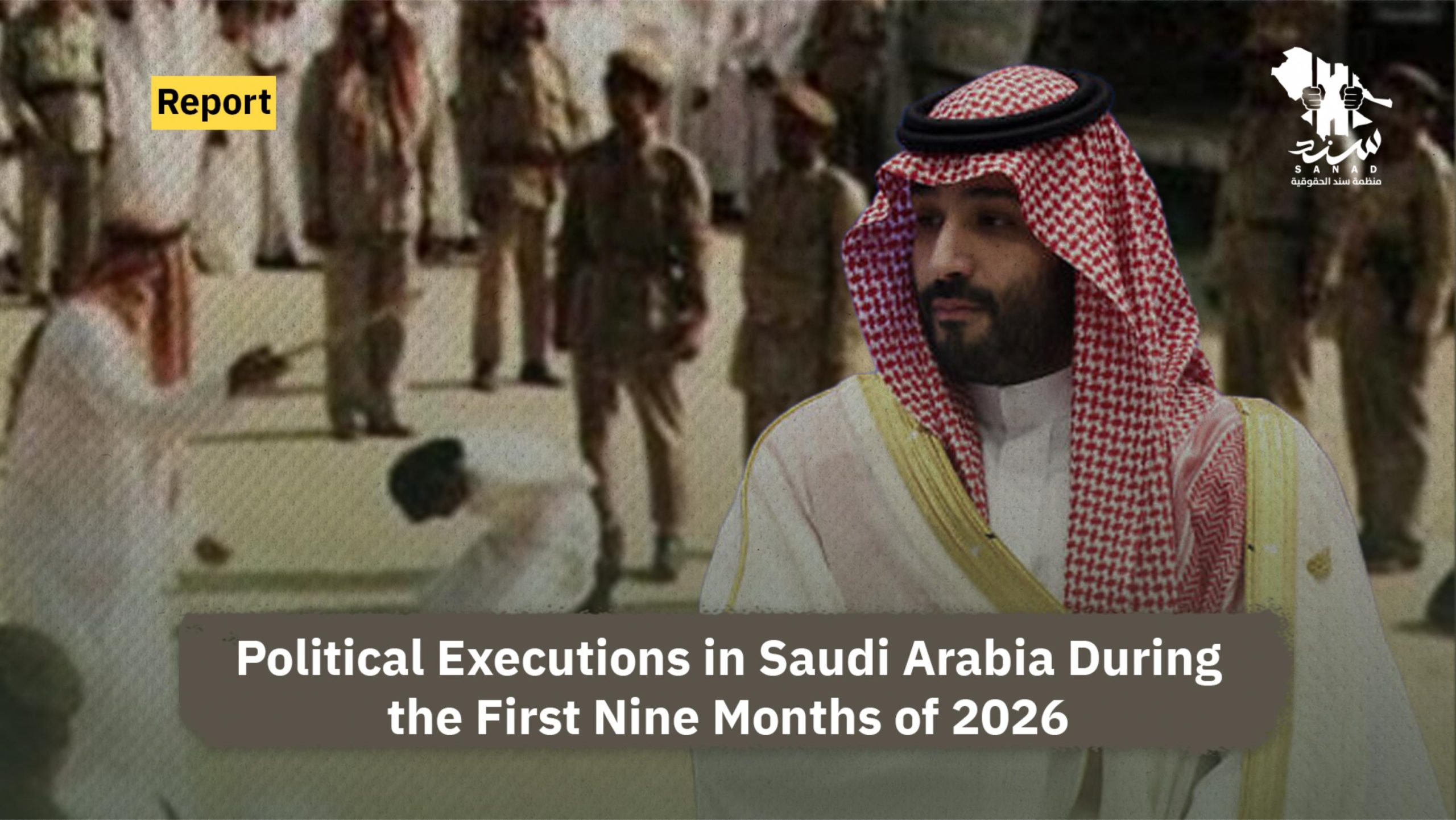
Political Executions in Saudi Arabia During the First Nine Months of 2026
Saudi authorities have continued to use the death penalty in 2026 as a political tool to silence independent voices and intimidate society, following 2025, which recorded the highest number of executions since human rights documentation began.
In this report, SANAD Human Rights Organization documents ten politically motivated executions, all carried out as ta’zir (discretionary) punishments, based on vague charges involving terrorism and membership in a foreign terrorist organization, without disclosing the name of any organization, presenting evidence, or ensuring fair-trial guarantees. Meanwhile, the total number of executions in Saudi Arabia in 2026 has exceeded 171.
Among those executed was Ali Al-Subaiti, the youngest political detainee sentenced to death in the Kingdom. He was arrested in 2017 at the age of 18, while the acts attributed to him dated back to when he was a minor.
2025: The Deadliest Year
SANAD Human Rights Organization documented 356 executions in 2025, the highest annual figure since documentation of executions in the Kingdom began. These included 45 politically motivated executions.
Among those executed was journalist Turki Al-Jasser, who was put to death over critical views expressed through a pseudonymous social media account.
This was not the first case of its kind. Saudi citizens have previously been executed or sentenced over tweets, as illustrated by the case of Dhafer Al-Shahri.
Political Executions in 2026
1. Executions on 7 January – Qassim
Saudi authorities executed Rayan Al-Dubaikhi, Mohammed Al-Thuwaini, and Abdulrahman Al-Ayyiri as ta’zir punishments.
According to a Ministry of Interior statement, the three men were accused of joining a foreign terrorist organization and other offenses, including financing terrorism and concealing the whereabouts of wanted suspects.
The statement did not identify the alleged organization or provide details of specific acts or evidence supporting the accusations.
2. Executions on 18 January – Riyadh
In the second mass execution within a single month, Saudi authorities executed Hussein Al-Omari, Saud Al-Anazi, and Bassam Al-Subaie as ta’zir punishments on charges of terrorism and joining a foreign terrorist organization.
The authorities did not identify the alleged organization or publicly disclose any independent evidence supporting the accusations against them.
3. Execution on 1 April – Eastern Province
Saudi authorities executed Saud bin Mohammed Al-Faraj as a ta’zir punishment.
The Ministry of Interior stated that he had been convicted of joining a foreign terrorist organization, establishing a cell inside the Kingdom, and offenses related to financing and providing shelter.
As in previous cases, the authorities did not disclose the organization’s name, publicly available evidence, or details of the trial proceedings.
4. Executions on 9 April – Eastern Province
Saudi authorities executed Ali bin Hassan Al-Subaiti and his uncle, Mustafa bin Saleh Al-Subaiti.
According to human rights sources, Ali was the youngest political detainee sentenced to death in Saudi Arabia. He was 27 years old when executed, having been detained since 2017, when he was arrested at the age of 18 while attempting to obtain a driver’s license, despite not being wanted by security authorities.
All the charges against him related to acts allegedly committed when he was a minor. These included:
-
Participating in demonstrations at the age of 12.
-
Concealing information about individuals accused of robbery.
-
Calling for and participating in protests.
-
Financing terrorism by receiving and transferring money.
These charges do not meet the threshold of the most serious crimes under international law.
According to human rights sources, Ali disclosed serious violations during his trial, including denial of contact with his family, denial of access to a lawyer, more than eight months in solitary confinement, severe torture, and being forced to sign confessions under duress.
Furthermore, Saudi Arabia’s Juvenile Law does not permit sentences exceeding ten years, making his execution a clear violation of domestic legislation and international law, which prohibits executing individuals for offenses committed when they were minors.
5. Execution on 15 September – Qassim
Saudi authorities executed Suleiman Amjad Hussein as a ta’zir punishment in the Qassim region on charges described by the Ministry of Interior as terrorism-related.
His execution brought the number of documented politically motivated executions since the beginning of the year to ten.
Recurring Patterns in Political Executions
First: Distorting the Definition of Terrorism
Saudi authorities use the term terrorism so broadly that it encompasses peaceful expression, participation in protests, and posting on social media.
The accusation has shifted from describing specific acts of violence to serving as a legal pretext for criminalizing dissent and criticism.
SANAD emphasizes that tweeting and expressing opinions do not constitute terrorism, and labeling such activities as terrorism distorts the meaning of the term.
Ministry of Interior statements repeatedly use the same general accusations: joining an unidentified foreign terrorist organization, concealing information about alleged terrorists without specifying the individuals involved, and financing terrorism without explaining the underlying acts.
Second: Discretionary Executions (Ta’zir)
All ten executions were carried out as ta’zir punishments, meaning they were based on judicial discretion and personal judgment rather than a fixed, definitive religious legal provision.
This gives the judiciary broad discretion to politicize sentences and use them against political opponents, undermining fundamental standards of justice and fair-trial guarantees.
The absence of a codified penal system also creates opportunities for inconsistent and arbitrary sentencing.
Third: Coerced Confessions and Lack of Legal Safeguards
Political cases repeatedly involve accounts of prolonged solitary confinement, denial of access to lawyers and family members, and torture to extract confessions.
The Convention Against Torture, to which Saudi Arabia is a party, prohibits the use of statements obtained through torture as evidence in judicial proceedings.
Nevertheless, death sentences in these cases continue to be based on confessions allegedly extracted through such practices.
Fourth: Execution of Juvenile Offenders
The Convention on the Rights of the Child, ratified by Saudi Arabia, prohibits imposing the death penalty for offenses committed by individuals under the age of 18.
Ali Al-Subaiti’s case is not an isolated incident. Saudi Arabia has executed individuals for offenses committed when they were minors despite warnings from the United Nations and findings by UN experts.
Fifth: Executions of Journalists and Prisoners of Conscience
In 2025, Saudi authorities executed journalist Turki Al-Jasser over critical tweets published through a pseudonymous account.
Several scholars and intellectuals remain imprisoned in Saudi Arabia on terrorism-related charges, with the Public Prosecution seeking the death penalty against some of them.
This means the risk of similar executions remains.
Violations of International Law
The executions documented in this report violate several legal frameworks:
1. International law: In countries that have not abolished the death penalty, its use is restricted to the most serious crimes. Peaceful expression and protest do not fall within this category.
2. Convention on the Rights of the Child: Prohibits the death penalty for offenses committed before the age of 18.
3. Convention Against Torture: Prohibits reliance on confessions obtained through torture.
4. Domestic legislation: Saudi Arabia’s Juvenile Law establishes a maximum sentence of ten years.
The executions documented in this report contravene these legal frameworks.
Recommendations
SANAD Human Rights Organization calls on Saudi authorities to:
-
Immediately halt all politically motivated executions.
-
Overturn sentences imposed on detainees for peaceful expression or participation in protests and release them.
-
Review death sentences imposed on individuals for offenses allegedly committed when they were minors.
-
Conduct independent and effective investigations into allegations of torture and coerced confessions, and exclude any evidence obtained through such practices.
-
Amend counterterrorism legislation to restrict the definition of terrorism to serious acts of violence and prevent the criminalization of peaceful expression.
-
Codify ta’zir punishments through clear legal provisions that limit judicial discretion.
SANAD Human Rights Organization also calls on the international community and the United Nations to:
-
Publicly pressure Saudi authorities to halt executions and make respect for human rights a condition of bilateral relations.
-
Activate UN Special Procedures mechanisms and demand official explanations for each case.
-
Support human rights efforts to document violations and hold those responsible accountable.