
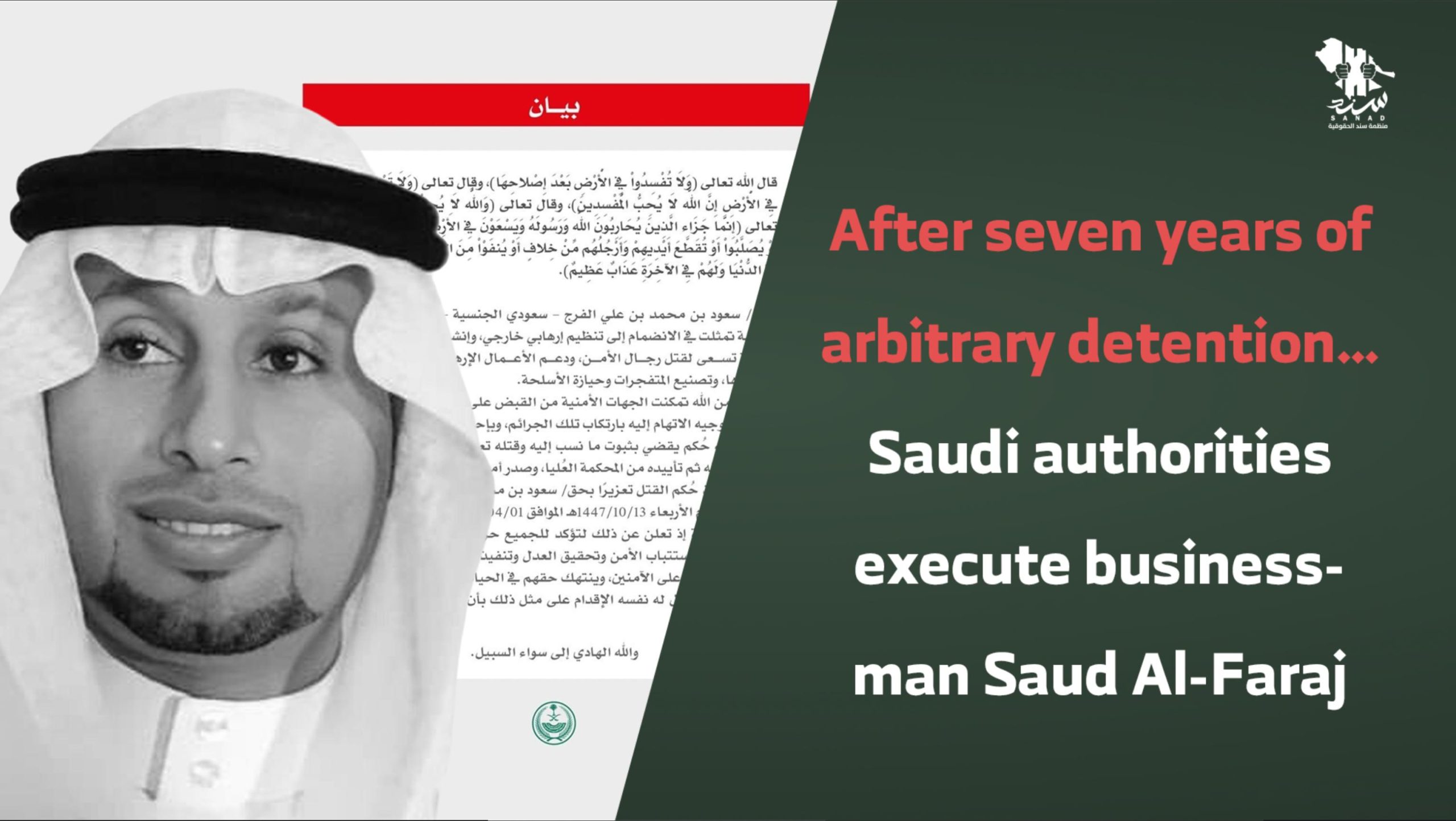
After seven years of arbitrary detention… Saudi authorities execute businessman Saud Al-Faraj
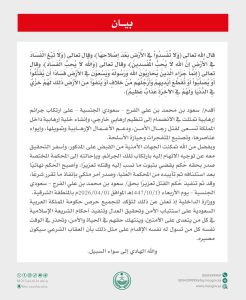 Saudi authorities executed Saud Al-Faraj on Wednesday, April 1, 2026, in the Eastern Province, following a court ruling on alleged terrorism-related charges, nearly seven years after his arrest in 2019.
Al-Faraj, a businessman born in 1980 from Al-Awamiyah, was arrested on December 2, 2019, after a violent raid on his home without a warrant or explanation. His arrest came in the context of his previous participation in protests in Qatif during the Arab Spring, as well as his refusal in February 2017 of a request from a security official to persuade a group of young men to travel to Iran, Lebanon, and Iraq for military training in exchange for funding and then report on them. Following his refusal, he was threatened, and prior to his arrest he faced pressure measures, including the suspension of his services in 2016 to pressure his brother, human rights defender Hussein Al-Faraj, to surrender himself.
During the arrest, Al-Faraj’s wife and daughter were detained with him, and he was later misled into believing they remained in custody in order to pressure him psychologically and extract confessions. He was transferred blindfolded and forced to sign documents without knowing their contents, marking the beginning of a long series of serious violations during his detention.
Al-Faraj was subjected to enforced disappearance for a period after his arrest, denied access to a lawyer for a long time, and held in solitary confinement for one year and nine months under harsh conditions, isolated from the outside world. During interrogation, he was subjected to severe physical torture that caused him to lose consciousness multiple times, and he was transferred to the hospital several times in a wheelchair. He was also stripped of his clothes during one interrogation session, subjected to humiliation and harassment, and explicitly threatened by investigators that he would be forced to watch his wife being raped if he did not confess, which ultimately led him to sign coerced confessions under duress.
Despite confirming before the court that these confessions were extracted under torture and submitting multiple complaints about the violations he suffered, no investigation was conducted. The court relied on these confessions as primary evidence in his conviction, and his case was marred by procedural violations, including charges that were not originally included in the investigation records and denial of adequate defense rights.
The Public Prosecution charged Al-Faraj with calling for and participating in protests and sit-ins, communicating with human rights organizations, and belonging to a “terrorist organization”—charges that do not fall under the most serious crimes under international law. He was sentenced to death by the Specialized Criminal Court based on broadly worded counterterrorism laws that are used to criminalize peaceful activities and expressions that do not align with the authorities.
In its Opinion No. 26/2024, the UN Working Group on Arbitrary Detention concluded that Saud Al-Faraj’s detention was arbitrary, noting that he was arrested without a warrant, subjected to enforced disappearance and prolonged solitary confinement, and denied a fair trial. It also stated that his conviction was based on confessions extracted under torture and that his case was linked to his exercise of fundamental rights, including freedom of expression and assembly.
The UN working group called for his immediate release, compensation, and an investigation into the violations he suffered, and for those responsible to be held accountable, as well as a review of relevant legislation, particularly counterterrorism laws, to ensure compliance with international standards. It also referred the case to the Special Rapporteur on torture. Despite this, Saudi authorities proceeded with his execution.
SANAD Human Rights Organization condemned the execution of Saud Al-Faraj, considering it a grave violation of the right to life, especially given the serious violations of fair trial standards in his case. The organization stressed that the use of terrorism charges to criminalize peaceful activity and the implementation of death sentences following unfair trials represent a troubling pattern that requires urgent international action to halt such violations and hold those responsible accountable, foremost among them Crown Prince Mohammed bin Salman.