
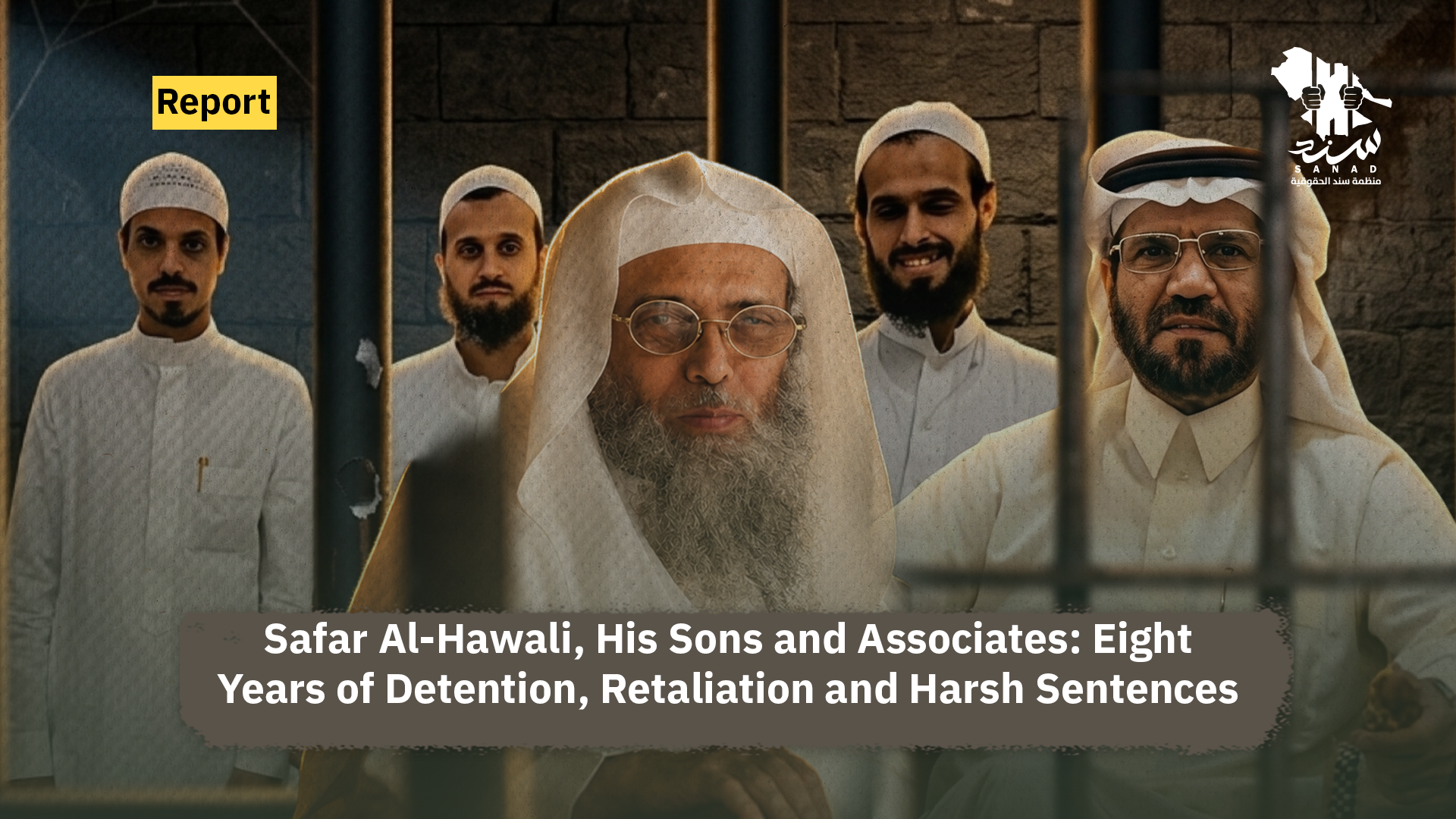
Safar Al-Hawali, His Sons and Associates: Eight Years of Detention, Retaliation and Harsh Sentences
Eight years have passed since a wave of arrests began in July 2018 targeting Dr. Safar bin Abdulrahman Al-Hawali and several members of his family and close circle. Alongside him, Saudi authorities arrested his sons Abdullah, Abdulrahman, Abdulrahim and Ibrahim, his brother Saadullah Al-Hawali, and his office manager, Dr. Ismail Al-Hassan. Ibrahim was later released after approximately seven months, while the others remain detained to this day amid harsh sentences and multiple forms of systematic torture.
The arrests of Dr. Safar Al-Hawali’s sons, brother, and office manager were not separate from his case. Rather, they appeared to form part of a pattern of pressure and retaliation targeting his family and close associates, turning family and professional ties into additional means of exerting pressure on him and compounding his psychological suffering.
The UN Working Group on Arbitrary Detention explicitly expressed concern over harassment and reprisals against members of Al-Hawali’s family and called on Saudi authorities to ensure that his relatives were not subjected to retaliation because of his views or activities. The UN Committee on the Rights of Persons with Disabilities also called for an end to all reprisals against Al-Hawali and his family, investigations into such acts, and accountability for those responsible. However, Saudi authorities failed to implement these demands, prompting the Committee, in April 2026, to classify Saudi Arabia’s implementation of its recommendations in Al-Hawali’s case as Category (C) – non-compliance.
Raid on Dr. Safar Al-Hawali’s Home and His Arrest
On 12 July 2018, Saudi authorities arrested Dr. Safar Al-Hawali following the leak of a draft book in which he discussed the political situation in the Kingdom, criticized several government policies, and offered advice to society, religious scholars, and the ruling family.
According to documentation by SANAD Human Rights Organization, the arrest took place during a violent raid on his home involving several security officers. The raid included forceful banging on doors and the storming of the house. According to information received by SANAD, one of Al-Hawali’s daughters suffered severe psychological trauma during the raid that left her unable to speak.
Dr. Al-Hawali was already suffering from serious health conditions at the time of his arrest. The UN Committee on the Rights of Persons with Disabilities documented disabilities affecting his communication, mobility, and ability to care for himself, including chronic apraxia of speech, as well as a fractured pelvis and kidney failure requiring continuous care.
According to the Committee, the authorities did not disclose his fate or whereabouts until 17 September 2018. For prolonged periods, he was denied family visits, legal assistance, reasonable accommodations, and the medical and rehabilitative care required by his condition.
Repeated UN Calls for His Release and an End to Reprisals Against His Family
UN Working Group on Arbitrary Detention
The UN Working Group on Arbitrary Detention issued Opinion No. 26/2023 concerning Safar Al-Hawali’s case, concluding that his deprivation of liberty was arbitrary and fell within Categories I, II, III and V of its classifications of arbitrary detention.
The Working Group found that his detention was linked to his peaceful exercise of the rights to freedom of opinion and expression and participation in public affairs, constituting violations of rights protected under Articles 7, 19 and 21 of the Universal Declaration of Human Rights.
It also noted that Al-Hawali had been denied access to a lawyer from the beginning of his detention, preventing him from effectively challenging the legality of his deprivation of liberty.
The Working Group further expressed concern over reports of harassment and reprisals against his family members, particularly the arrest of relatives as a form of punishment connected to his activities and views. It called on the Saudi government to ensure that his relatives were not subjected to reprisals because of his activities or their own exercise of fundamental rights.
The Working Group concluded that the appropriate remedy was to immediately release Safar Al-Hawali, provide him with an enforceable right to compensation and other forms of reparation, and conduct an independent investigation into the circumstances of his detention and the violations associated with it.
Committee on the Rights of Persons with Disabilities: Arbitrary Detention, Enforced Disappearance and Violation of the Right to Health
In its decision on Al-Hawali’s case, adopted on 19 March 2024, the UN Committee on the Rights of Persons with Disabilities concluded that his arrest and detention amounted to serious human rights violations.
The Committee found that the delay in acknowledging his deprivation of liberty and disclosing his whereabouts amounted to enforced disappearance. It also concluded that his detention and treatment, as well as the delay in bringing him to trial, were unjustified, unreasonable and therefore arbitrary.
The Committee further found violations of his right of access to justice and his right to the highest attainable standard of health without discrimination on the basis of disability.
It also concluded that the level of suffering caused by his prolonged isolation violated his right to physical and mental integrity and his right not to be subjected to torture or cruel, inhuman or degrading treatment or punishment.
The Committee called on Saudi Arabia to review his case to ensure that he receives a fair and public trial before a competent, independent and impartial tribunal or to release him. It also called for an end to reprisals against him and his relatives, investigations into such acts and accountability for those responsible, as well as an effective remedy and adequate healthcare and reasonable accommodations for persons with disabilities in detention.
Before issuing its final decision, the Committee had already intervened through urgent measures. Beginning in November 2020 and again in December 2022, Saudi authorities were asked to take steps to prevent irreparable harm, including releasing Al-Hawali and ensuring that he received appropriate care.
UN Expert Prevented from Meeting Al-Hawali at Al-Ha’ir Prison
In April 2025, Claudia Mahler, the UN Independent Expert on the enjoyment of all human rights by older persons, conducted an official visit to Saudi Arabia from 20 to 30 April.
During her visit to Al-Ha’ir Prison in Riyadh, she requested meetings with Safar Al-Hawali and Salman Al-Odah. Prison authorities refused to allow her to meet them, despite having been informed in advance of her request.
Mahler expressed regret over the refusal, stating that preventing her from meeting detainees was inconsistent with the terms of reference governing visits by UN Special Procedures mandate holders, which include the ability to communicate confidentially and without supervision with persons deprived of their liberty.
UN Classifies Saudi Arabia as Non-Compliant
In its follow-up report adopted during its 34th session in March 2026, the Committee on the Rights of Persons with Disabilities reassessed Saudi Arabia’s implementation of its recommendations in the cases of Safar Al-Hawali and Salman Al-Odah.
The Committee expressed regret that no measures had been taken to implement its individual and general recommendations and noted that no information had been provided demonstrating concrete steps to implement its previous requests.
It therefore decided to close the follow-up procedure with a Category (C) assessment, meaning that the state had submitted a response but that the measures taken did not implement the Committee’s views and recommendations.
Safar Al-Hawali’s case has therefore entered its ninth year amid a growing series of UN findings calling for his release and protection of his family from reprisals, while Saudi authorities continue to reject the implementation of these UN decisions.
Abdullah Safar Al-Hawali
Abdullah Safar Al-Hawali was arrested in July 2018 while attending a relative’s wedding with his brother, as part of the campaign targeting the family around the time of their father’s arrest.
According to SANAD’s documentation, he was detained without a legal warrant or any specific charge being presented to him at the time of his arrest. He was subsequently subjected to physical torture and prolonged sleep deprivation.
He was also denied family visits and regular communication with his relatives, as well as access to a lawyer, before undergoing judicial proceedings that lacked fair-trial guarantees.
In June 2022, the Specialized Criminal Court sentenced him to six years in prison. The Court of Appeal subsequently increased the sentence to 16 years. The harsher sentence prompted Abdullah and his two brothers to begin a hunger strike in January 2023 in protest against their sentences and detention conditions.
Abdulrahman Safar Al-Hawali
Abdulrahman Safar Al-Hawali was arrested in July 2018 as part of the same campaign targeting his father, brothers, and other members of the family’s close circle.
SANAD documented that during his detention he was subjected to enforced disappearance, physical torture, and sleep deprivation during the first months of his imprisonment. He was also denied visits from his children.
He later faced a trial that, according to information available to SANAD, lacked basic guarantees of justice.
Abdulrahman was initially sentenced to seven years in prison before the Court of Appeal increased his sentence to 17 years—an additional ten years beyond the original sentence. He was among the three brothers who announced a hunger strike in January 2023 to protest the increased sentences.
Abdulrahim Safar Al-Hawali
In July 2026, Abdulrahim Safar Al-Hawali completed eight years in detention since his arrest during the campaign targeting his father, brothers, uncle, and his father’s office manager.
Information documented by SANAD indicates that Abdulrahim was subjected to enforced disappearance, physical torture, and sleep deprivation for months during his detention.
In February 2020, he was subjected to a secret trial before the Specialized Criminal Court and sentenced to six years in prison. The Court of Appeal later increased his sentence to 15 years.
Abdulrahim also joined his brothers Abdullah and Abdulrahman in the hunger strike announced in January 2023 to protest their harsh sentences and ongoing violations.
Ibrahim Safar Al-Hawali
Ibrahim Al-Hawali, the youngest of Dr. Safar Al-Hawali’s sons, was among the family members targeted in the July 2018 arrests.
According to SANAD’s documentation, Ibrahim spent approximately seven months in detention without being charged and was denied contact with his family throughout that period.
Saudi authorities released him in 2019 after several senior family members pledged to present him to the authorities whenever requested.
Saadullah Al-Hawali
The targeting was not limited to Dr. Safar Al-Hawali’s sons but also extended to his brother, Saadullah bin Abdulrahman Al-Hawali.
In July 2018, security forces raided his home. According to SANAD’s documentation, the force included masked officers who surrounded and stormed the house, terrorized his family members, and then took him to an unknown location.
Following his arrest, Saadullah was denied communication with his family and access to a lawyer.
He was subsequently subjected to enforced disappearance and a secret trial that lacked fair-trial standards. He was initially sentenced to four years in prison before the Court of Appeal increased his sentence to 14 years.
Ismail Al-Hassan
The wave of arrests that began in July 2018 also targeted Dr. Ismail Al-Hassan, Dr. Safar Al-Hawali’s office manager.
Al-Hassan was arrested around the same time as Safar Al-Hawali, his sons and his brother. He was subsequently sentenced to 10 years in prison before the Court of Appeal increased his sentence to 12 years. Little information is available regarding his detention conditions or the violations he has suffered.
SANAD Calls for the Immediate Release of Safar Al-Hawali and His Sons
SANAD Human Rights Organization renews its condemnation of the continued detention of Dr. Safar Al-Hawali, his sons Abdullah, Abdulrahman and Abdulrahim, his brother Saadullah Al-Hawali, and his office manager Dr. Ismail Al-Hassan.
SANAD considers their continued detention, despite the serious violations documented by the organization and UN mechanisms and the explicit calls for their release, to represent an ongoing pattern of collective punishment and retaliation.
SANAD calls on Saudi authorities to immediately and unconditionally release them, overturn the sentences issued against them, and ensure that they receive compensation and adequate redress. It also calls for Dr. Safar Al-Hawali to be urgently provided with independent medical care appropriate to his age, disability and health condition, and to be granted full access to his family and lawyer.
SANAD further calls on the Saudi government to fully and immediately implement the relevant findings and decisions of UN mechanisms, particularly the opinion of the UN Working Group on Arbitrary Detention and the decision of the Committee on the Rights of Persons with Disabilities, and to end all forms of retaliation and harassment against Al-Hawali and members of his family.
SANAD also urges the United Nations, its human rights mechanisms, and international and regional organizations to intensify pressure on Saudi authorities rather than limiting their response to condemnations or calls that have remained unimplemented for years. It further calls for the case of Safar Al-Hawali and his family to remain a priority in all human rights dialogues and mechanisms concerning Saudi Arabia, and for more effective steps to be taken to press the authorities to comply with UN decisions and release the detainees.