
Saudi Arabia: Ongoing repression of women despite claims of reforms
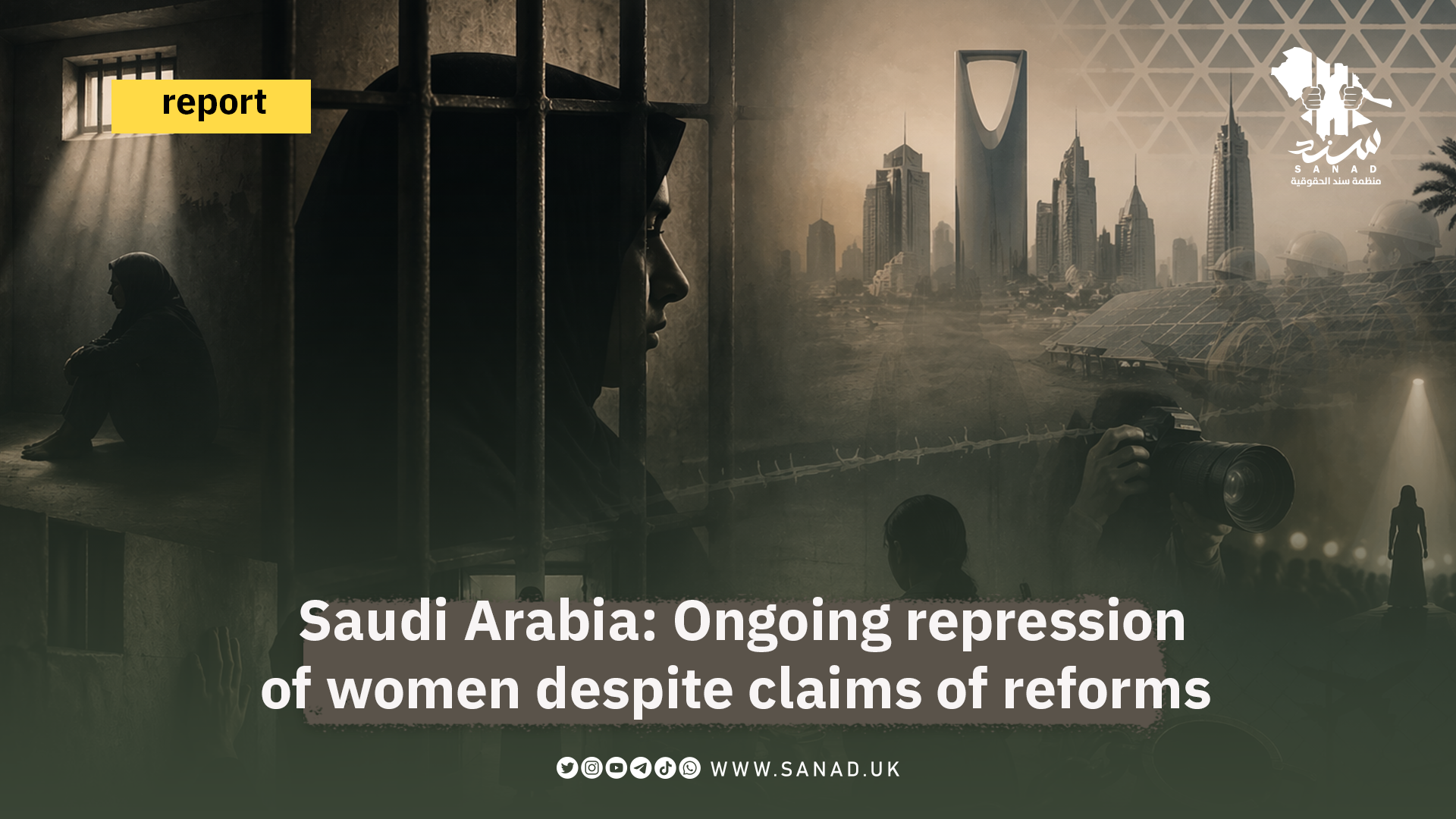
In recent years, Saudi Arabia has witnessed an unprecedented escalation in targeting women who express their opinions or engage in peaceful activities. The crackdown has extended to various groups of women who have faced harsh judicial sentences, reaching decades of imprisonment, based on vague charges related to expression, communication, or social activity.
The situation goes beyond arrest, as women have been subjected to various forms of torture and mistreatment. This report highlights the ongoing reality that women continue to face behind bars, where their suffering intersects with enforced disappearances, medical neglect, and arbitrary detention due to their opinions, activities, or even family relations. This reveals a constrained environment where multiple forms of suppression of basic freedoms are practiced.
Simultaneously, working women suffer from exploitative working conditions, including wage theft, lack of rest, and restrictions on their freedom of movement due to the kafala system. This occurs in the absence of effective protective mechanisms that ensure fairness and accountability. It reflects a broader issue of systemic discrimination and weak legal safeguards, showcasing an environment where basic rights are violated across multiple levels.
In contrast to this reality, there have been intensified efforts in recent years to present a different image internationally by promoting a series of reforms that are portrayed as substantial transformations in women’s conditions. However, this proclaimed image is highly contradictory to the actual reality, as these reforms do not reflect in a tangible way the guarantee of rights and freedoms, or true empowerment for women. This discrepancy reflects a trend of improving the public image more than a commitment to genuine change.
This report highlights these discrepancies by documenting the violations women face in the Kingdom and emphasizing the broader context in which these practices occur.
Women Behind Bars
At least 14 women are currently in Saudi prisons due to their peaceful stances or expressing their opinions, with cases ranging from social media posts, involvement in human rights activities, to even communicating with family members.
For instance, the elderly Aida Al-Ghamdi (67 years old) was arrested in March 2018 due to her communication with her opposition son, Abdullah Al-Ghamdi, who resides in the UK. She was sentenced to 16 years in prison. Similarly, Maha Al-Huwaiti was arrested in February 2021 in front of her five children due to tweets criticizing living conditions. She was sentenced to 23 years in prison. In May of the same year, Najwa Al-Humaid was arrested for expressing her opinion online and is still detained today.
The year 2021 also saw the arrest of Noura Al-Qahtani for tweets in which she called for the release of prisoners of conscience. She was sentenced to an extreme 45 years in prison with a similar travel ban, making it the longest sentence imposed on a Saudi woman. Activist Rina Abdulaziz was also arrested that year for her opinions and suffers from medical neglect in prison despite having a lung disease. In a similar case, Aya Al-Jahani has been detained since 2016, held in solitary confinement for an extended period, and her fate remains unknown despite her sentence having ended.
The violations extended to other women arrested under harsh conditions, such as Aisha Al-Mahjari, who was arrested for teaching the Quran in her home, and Zana Al-Shahri, who remains in custody since 2019 due to her writings. Dhalal Al-Khalil was arrested in 2017, and her condition remains unknown due to a lack of information. Meanwhile, Amani Al-Zain has been forcibly disappeared since her arrest in 2020 following the publication of content considered critical of Crown Prince Mohammed bin Salman.
Other cases include Israa Al-Ghamgam, arrested for her participation in peaceful protests, sentenced to 13 years after calls for her execution. Journalist Maha Al-Rifidi was arrested in 2019, and despite completing her sentence, she remains detained. Additionally, the case of Manahel Al-Otaibi, arrested in 2022 and subjected to severe violations in prison, as well as Manal Al-Qufiri, arrested as a minor and sentenced to 18 years for tweets.
Amid the Saudi authorities’ claims of implementing reforms for women’s rights, these cases reveal a troubling pattern of violations faced by women in the kingdom. Broad laws are used to criminalize freedom of expression, and harsh, disproportionate sentences are imposed. There are also repeated reports of enforced disappearance, mistreatment, and medical neglect. Furthermore, some detainees are deprived of their basic rights, including release after the completion of their sentences.
Saudi Women in the International Spotlight: A Propaganda Image and a Constrained Reality
In recent years, Saudi Arabia has intensified efforts to improve its international image, attempting to cover up human rights violations, including those concerning women’s rights. As part of these efforts, the Kingdom has appointed women close to the government in key positions, aiming to showcase what is labeled as “women’s empowerment” and to project an improved picture of the status of women in the country.
The authorities have employed multiple strategies to enhance this image, including investments in the entertainment, sports, and cultural sectors, as well as attracting public figures and global influencers. The Saudi government has also launched media platforms and content that promotes an official narrative about the ongoing transformations in the country. Additionally, major economic institutions like the Public Investment Fund (PIF) have funded international media projects that contribute to portraying a positive image of the Kingdom, focusing on “success stories” related to women, while ignoring the broader human rights context.
However, international investigative reports have revealed that there has been collaboration between Saudi entities and global media institutions to produce paid content that highlights issues like women’s empowerment, while the ongoing violations, particularly against women, are either omitted or marginalized. These developments show that improving the image of the Kingdom is not limited to domestic rhetoric but is extended to the international space through media and investment partnerships aiming to influence global public opinion and reshape perceptions of the Kingdom’s human rights record.
Despite this organized effort, a stark contradiction remains between the publicized image and the actual reality. Human rights reports continue to document unprecedented and disturbing patterns of violations against women, including arbitrary detention, enforced disappearance, mistreatment, medical neglect, and the imposition of harsh sentences based on vague charges related to peaceful expression. These cases show that some women, who are celebrated in official discourse, do not represent the reality of the majority, and their presence is used as part of a broader strategy to showcase progress, while the voices of critics or independent voices are silenced.
This discrepancy between discourse and practice reflects a trend toward using women’s issues as a tool in foreign policy, rather than a genuine commitment to structural reforms that ensure rights and freedoms. Instead of addressing the root causes of violations, the focus remains on highlighting selective indicators of progress without providing legal and institutional guarantees that protect women from discrimination or abuse. Furthermore, the continued restrictions on freedom of expression and civil work undermine any claims of achieving true and comprehensive empowerment.
In the latest investigation revealing the methods of reputation laundering, an investigation by The Guardian newspaper disclosed collaboration between the commercial arm of the BBC and the Public Investment Fund to produce media content that whitewashes the Kingdom’s image internationally. The investigation revealed that BBC Storyworks, funded by Saudi Arabia’s sovereign wealth fund, produced media content, including films and articles, promoting the official narrative of “women’s empowerment.” The investigation also covered the role of PIF in using investments and media production as tools, alongside entertainment and sports, to boost the Kingdom’s global influence and improve its public image in the context of a broader reputation laundering effort tainted by extensive human rights violations.
In this context, Fahd Al-Ghoidi, the official spokesperson for the “SAND” human rights organization, stated: “SAND believes that using women’s issues as a propaganda tool to improve international image is a form of ‘reputation laundering.’ It is impossible to talk about women’s empowerment when at the same time journalist Maha Al-Rifidi is being detained. Real empowerment for women requires the immediate and unconditional release of all detainees, fair compensation for them, and the provision of legal and human rights guarantees that protect women and ensure their basic rights.”
Al-Ghoidi added: “There is a massive contradiction between what Saudi authorities publish internationally about women’s empowerment and what is actually happening on the ground. While enormous amounts are spent on image and reputation enhancement campaigns, using women as a front for these campaigns, Saudi women face extremely harsh and unjust prison sentences for expressing their opinion or communicating, such as Noura Al-Qahtani, who was sentenced to 45 years in prison, and Aida Al-Ghamdi, who was arrested at the age of 67 and sentenced to 16 years for communicating with her son.”
Working Women in Saudi Arabia: Incomplete Rights and Lack of Protection
Women workers in Saudi Arabia, particularly domestic workers, face difficult circumstances characterized by weak legal protection compared to other workers. Labor laws do not fully cover them, making them more vulnerable to exploitation. Additionally, the continuation of the sponsorship system limits their freedom to change jobs or leave the country without their employer’s permission, placing them in a vulnerable position and increasing the likelihood of repeated violations, especially given the limited oversight of working conditions within households.
Many of these women endure harsh working conditions, working long hours without sufficient rest or holidays, and sometimes not receiving their wages regularly. They also face inappropriate living conditions and complete isolation due to restrictions on their movement or the confiscation of their communication devices, which increases their sense of loneliness and vulnerability. In some cases, they experience degrading treatment or violence in various forms, with no effective mechanisms to ensure their protection or justice.
Overall, these conditions reflect another issue related to the absence of equality in legal protection, which remains fragile in Saudi Arabia. There are also patterns of discrimination and racism, especially against migrant workers. Despite the announced reforms, the suffering of these women continues, as their safety and dignity largely depend on the behavior of their employers, rather than on clear and fair legal guarantees to protect their rights.
Calls for Structural Reforms to Ensure Women’s Rights in Saudi Arabia
In this context, the “SANAD” Human Rights Organization calls on Saudi authorities to:
- Immediately and unconditionally release all women detained for peacefully exercising their rights to free expression or civil activity.
- Review the laws and legislation used to restrict freedom of expression, ensuring their alignment with international human rights standards, and ending the use of vague charges.
- Conduct independent and transparent investigations into all practices of torture and ill-treatment, hold those responsible accountable, and ensure compensation for the victims.
- Guarantee the right to healthcare for all detainees and establish effective monitoring mechanisms for prison and detention center conditions.
- End practices of enforced disappearance and disclose the fate of all forcibly disappeared individuals, ensuring that detainees are allowed to communicate with their families and lawyers.
- Reform labor laws to include domestic workers, abolish or amend the sponsorship system to ensure freedom of movement and work, and provide equal legal protection for all workers.
- Strengthen protection and accountability mechanisms in cases of violence and exploitation, and provide safe and effective channels for complaints without fear of retaliation.
- Ensure the independence of civil society and allow human rights organizations to operate freely, contributing to monitoring violations and defending victims.
- Align policies with international commitments, especially those related to women’s rights, and translate them into measurable, practical actions.
- Stop using women’s issues for propaganda purposes and work toward achieving empowerment based on rights and the rule of law.