
Six Saudi Citizens Arrested on Expression-Related Charges After Showing Solidarity With Social Security Beneficiaries
In recent weeks, the Saudi Ministry of Human Resources and Social Development introduced amendments to social security eligibility rules, adding burdensome new requirements. Among them was the stipulation that beneficiaries must have a formal lease for an independent residence—a condition that excludes large segments of vulnerable people, including those with disabilities who cannot live alone or those whose limited social security stipends are insufficient to secure even the most basic housing.
As a result, widespread criticism emerged across social media, with thousands urging the ministry to revise these rules and consider people’s circumstances. In response, Saudi authorities—through online troll networks and government-aligned influencers—launched smear campaigns against critics. A businessman closely linked to the Minister of Human Resources publicly defended the government’s decisions, prompting many citizens to launch a boycott campaign against his companies.
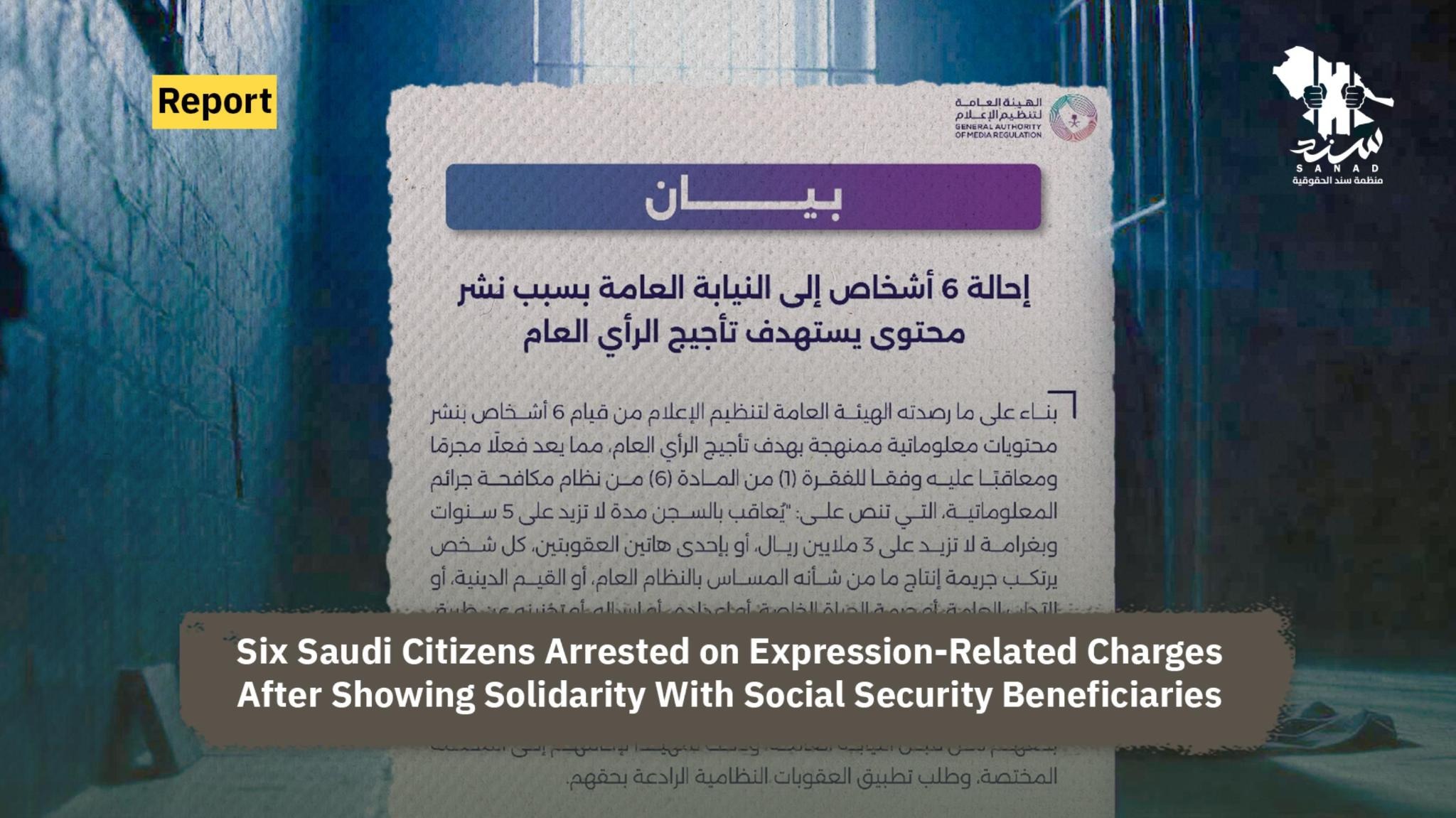
Shortly afterward, on 27 November, the General Commission for Audiovisual Media—a government body—announced the arrest and referral of six individuals to the Public Prosecution over content allegedly intended to “incite public opinion.” According to circulating information, the six detainees are among those who criticized the ministry’s actions or joined the boycott campaign against the businessman’s brands.
The Commission stated that the detainees could face up to 5 years in prison and fines of up to 3 million SAR under Article 6 of the Anti-Cybercrime Law—a law that has effectively become a tool for silencing dissent and weaponizing legislation against peaceful expression. Saudi authorities increasingly rely on this law to criminalize tweets, criticism, or any form of public demand for rights.
In Saudi Arabia today—particularly since Crown Prince Mohammed bin Salman assumed power—criticizing government decisions is treated as a crime, instantly reframed as “inciting public opinion” or “targeting public order,” even though such statements are protected under widely recognized free-expression norms.
This crackdown is not isolated. There are hundreds of documented arrests of citizens who spent years in prison for tweets. Saudi authorities executed journalist Turki Al-Jasser over Twitter activity, executed Dhafer Al-Shahri over a tweet, and continue to detain Fares Al-Dalilah simply for demanding his rights from a government institution.
SANAD Human Rights Organization affirms that this series of arbitrary actions, repression of citizens, and mass arrests targeting peaceful critics or participants in online campaigns constitutes a blatant violation of human rights and the most basic principles of freedom of expression. The organization holds Saudi authorities fully responsible for the safety of the six detainees referred by the Media Regulatory Authority, along with all others imprisoned for expressing their opinions.
SANAD calls for the immediate and unconditional release of everyone detained over peaceful expression and urges Saudi authorities to end these unlawful repressive practices. The organization also calls on the international community and human rights bodies to assume their responsibilities and pressure Saudi Arabia to halt this dangerous deterioration in civil liberties.
Continuing a policy of criminalizing opinion and silencing dissent will only fuel further public frustration, undermine social stability, and deprive citizens of their fundamental rights.