

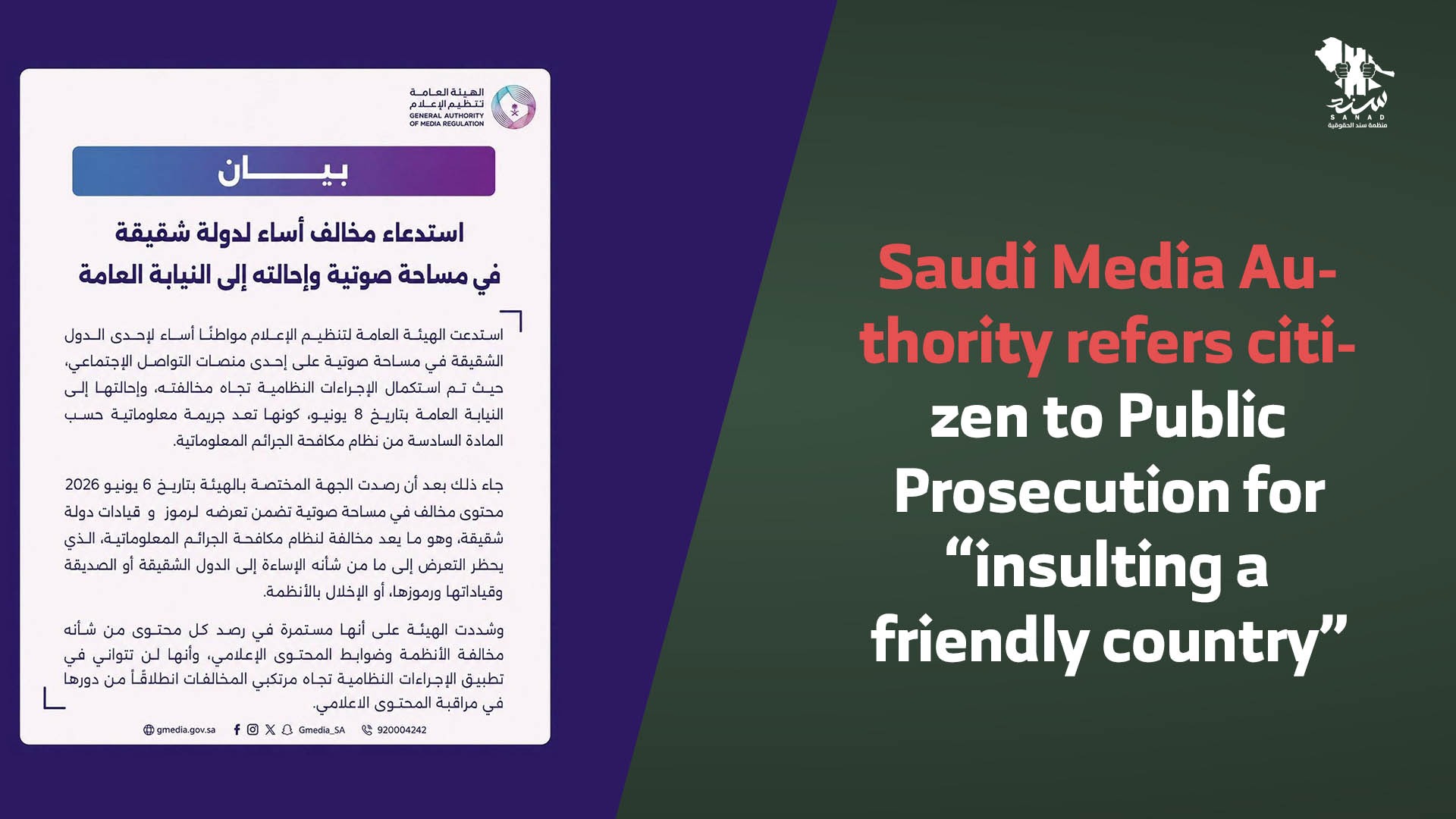
Saudi Media Authority refers citizen to Public Prosecution for “insulting a friendly country”
Saudi Arabia’s General Commission for Media Regulation announced that it had summoned a citizen accused of “insulting a friendly country” during a widely circulated audio discussion on a social media platform. The authority said it had completed the necessary legal procedures and referred the case to the Public Prosecution under the Cybercrime Law.
The incident comes amid a broader crackdown on freedom of expression in Saudi Arabia, where online platforms and audio discussion spaces are increasingly subject to strict monitoring. Broad and vague terms such as “insult,” “content violations,” and “breaching regulations” are frequently used to justify summoning individuals and referring them to investigative bodies.
Media outlets reported that the individual involved was Hussein Al-Shammari, an adviser at the Ministry of Media. However, SANAD Human Rights Organization said it was unable to independently verify these reports or confirm the identity of the person referenced in the authority’s statement.
The same authority previously announced on May 11 that it had summoned 49 individuals and referred them to media violations committees, reflecting its growing role as a censorship and enforcement body used to give a legal appearance to the prosecution of opinions and criticism. Numerous citizens have previously faced investigations and legal action over their views and online activities as part of an ongoing pattern of criminalizing peaceful expression.
SANAD stated that Saudi Arabia has become an increasingly repressive environment in which independent voices are targeted and hundreds of people have been detained over tweets, opinions, or peaceful online activities, in violation of fundamental rights, particularly freedom of expression.
The organization called on Saudi authorities to end arbitrary summonses, revoke measures targeting peaceful expression, and stop using media regulations and cybercrime laws to criminalize opinions and suppress public debate.